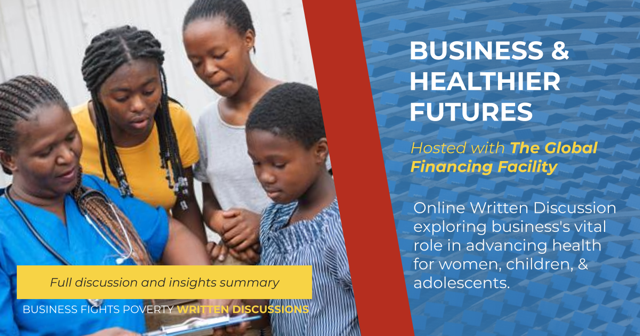
Over 4.5 million mothers and babies die each year from preventable conditions during pregnancy, birth or in the few weeks of life.
Investing in the health and rights of women, children and adolescents is a moral imperative, a human rights requirement and a key to achieving the Sustainable Development Goals.
Access to family planning services, safe births, postnatal care and good nutrition have the power to transform the health and opportunities of millions of people. It is also a smart economic choice that spurs economic growth and nurtures prosperous societies.
Despite this, there remains a severe funding gap which even before COVID-19 stood at an estimated $33bn per year globally. Now, over 60 countries are off-track to meet the Sustainable Development Goals’ targets for maternal, newborn and stillborn mortality reduction by 2030.
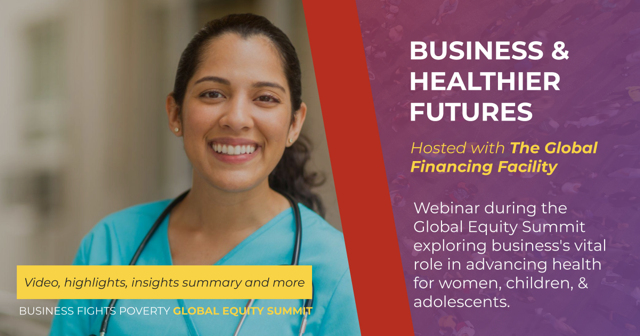
Business Fights Poverty partnered with the Global Financing Facility for Women, Children and Adolescents (GFF), in support of GFF’s #DeliverTheFuture campaign.
Our collaboration asked, “What is the role of the private sector in supporting governments to deliver healthier futures for women, children and adolescents?”
Between August and December 2023, we brought together a group of companies, policymakers, academics and civil society actors to explore key questions:
The collaboration provides practical insights, inspiring examples of positive action, and opportunities for connection between like-minded peers with an interest in this vital area.
The health of women, children and adolescents is intrinsically linked to business’ current and future workforce. Women make up nearly 40% of the world’s labour force, and globally 60% of garment sector workers and 43% of agricultural workers are women. Good health and nutrition is an important foundation for children’s learning, and all businesses have a vested interest in ensuring young people are able to take full advantage of educational opportunities and learn skills for future employment.
Businesses are an essential partner for governments to develop stronger health systems that meet the specific needs of women, children and adolescents.
Clearly, pharmaceutical companies and businesses that supply medical products and services are crucial to healthcare delivery and have a vital role to play, and the food and agriculture sectors are key to ensuring good nutrition.
There are also opportunities for companies with technical expertise to help drive innovation; for education companies to help deliver information and training; for investors and philanthropic foundations to develop creative models of finance to help plug the funding gap; and for multinationals with operations in low and middle-income countries to partner at the national level in support of government action plans.
Beyond this, all sectors can support the health of women, children and adolescents by working to support access to healthcare and health education for women and their families within their core operations and across their supply chains, as well as through philanthropic investments and leveraging their advocacy voice.
The GFF is a multistakeholder partnership housed in the World Bank. It was co-created in 2015 by the World Bank, health leaders, the United Nations, and civil society organisations in response to slow progress towards global health commitments, and high rates of maternal and child mortality in many countries. Its unique, country-led model of financing has been critical to accelerating health investments and spurring health progress and empowerment for women, children and adolescents in 36 low- and middle-income countries. To date, $2 billion has been committed to the Fund, unlocking over $32 billion of funds in partner countries. As a result of GFF’s catalytic investments and technical assistance:
Contact the Global Financing Facility here