Listen to this article (audio generated using AI assistance):
This year’s Immunisation Week, the annual campaign to expand vaccination globally, is rightly focussed on, “The Big Catch Up,” – getting countries back on track with routine vaccinations after pandemic-related disruptions. According to the CDC, outbreaks of vaccine-preventable diseases like measles, polio, and diphtheria are rising in every region.
Indeed even in a ‘high income’ region like Europe vaccination rates have been falling. Shockingly, 95% coverage rates needed to achieve measles herd immunity were missed in France, Germany, Italy, Spain, and the UK in 2021. And despite being officially ‘polio-free’ in 2003, the poliovirus was found in London in 2022, resulting in a catch-up and booster campaign across the capital.
Oft cited reasons for this overall decrease include complacency (old diseases don’t need a vaccine), confidence (growing misinformation and mistrust in politics and institutions) and convenience (challenges with accessing services). Perhaps less often cited is the fact that the large pockets of under-vaccinated groups in Europe tend to be those living in states of vulnerability, be it due to poverty, migration status or belonging to a particular racialised or religious group.
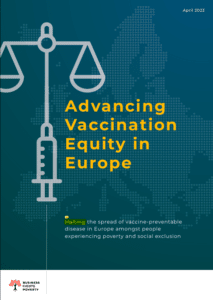
A new Business Fights Poverty Report has identified multiple examples where poverty and social exclusion have affected vaccination uptake across a range of vaccinations. For example,
- Vaccination levels within Roma communities across Europe rate very poorly in comparison with general population coverage, and a number of measles and hepatitis outbreaks over the past 10 years have included Roma communities.
- Children in Germany with insecure residence status are twice as likely to be incompletely vaccinated.
- A systematic review of 28 studies found low socio-economic status to be a key barrier to human papillomavirus vaccine uptake in Europe.
Why does vaccination equity matter?
- First and foremost vaccination inequity matters because those experiencing poverty and social exclusion are more at risk of catching vaccine preventable diseases. However as COVID showed us, everyone’s health is interconnected. Without herd immunity we are all at risk of the spread of preventable diseases – impacting lives and livelihoods.
- The EU has an ambitious ‘Beating Cancer Plan’, and vaccines play a role here too, with the HPV vaccine preventing ovarian cancer and the HBV and HCV vaccines preventing viral hepatitis and liver cancer. But lower levels of uptake amongst those experiencing poverty and social exclusion threaten these ambitions. Vaccines also remain vital to addressing antibiotic resistance and as yet unknown diseases that threaten global health security as COVID did.
- Finally, one of the main reasons vaccinations have been such a fundamental part of human progress – in addition to the fact they save on average 2-3 million lives per year, is that they have enabled economies and societies to flourish. They also represent a return on investment with one study showing that every 1 Euro invested could yield 4 euros of future economic revenue in return. These returns could perhaps be even greater if vaccination efforts were better targeted at where the need is greatest.
Despite a commitment to vaccination equity in the EU’s Immunization Agenda 2030 and the SDG 3 commitment to expanding universal healthcare to all, too little is being spent in reaching those living in poverty and social exclusion. In the new Business Fights Poverty report, we found that existing spending on vaccination equity by the EU appears to be low. Under the last EU health budget (2014–20), we have estimated that a total of €12 million out of €449 million was spent on projects that specifically aimed to reach excluded and under vaccinated groups – i.e., only around 2%.
The positive news is that research and programmes are currently underway to address vaccination equity and clear lessons are being learnt in how to reach those experiencing poverty and social exclusion. There just needs to be a lot more of it. For example, the COMSAVAC project in Spain, Greece, and Italy aims to scale up HBV vaccinations through a community based approach to screening amongst West African migrants and refugees. And the Innovative Immunisation Hubs project is establishing proactive partnerships with citizen groups, public health agencies, key stakeholders and the general public to improve access to vaccination in disadvantaged, isolated and difficult to reach population groups in 8 European countries.
In order to achieve the ‘Big Catch Up’ in Europe, a focus on equity will be essential. Overall, the report recommends that tackling vaccination equity requires attention by national governments and the EU in 3 key areas:
- The need for improved disaggregated data by key determinants of inequalities (e.g. employment status, geography, ethnicity and migration status)
- Enhanced access to services at hyper local levels, including through community pharmacies and mobile clinics.
- Overcoming the trust deficit that poor and socially excluded groups feel towards health and social institutions, which, for some, have been or are structurally racist. This includes developing co-created community solutions.
If you would like to find out more about the report or participate in future discussions on the issue please contact Alice@businessfightspoverty.org